
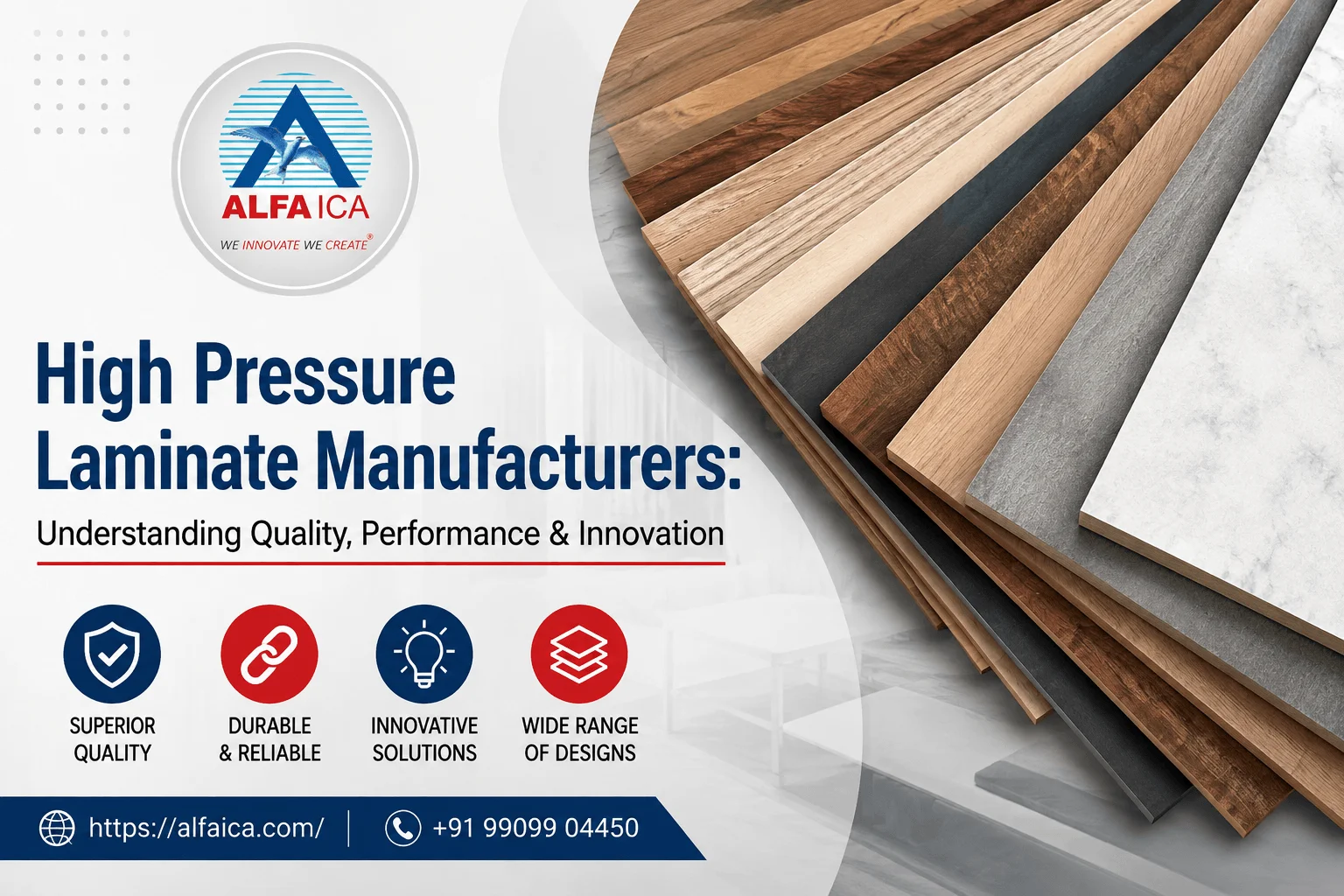
High pressure laminate (HPL) is widely used for furniture surfaces, wall panels, doors, countertops, cabinetry, partitions, and commercial interiors because it combines decorative flexibility with durability. However, the quality of an HPL sheet depends on much more than its appearance. Resin formulation, kraft paper treatment, pressing conditions, surface technology, thickness control, and quality testing all influence the finished product.
For buyers, architects, interior designers, contractors, and manufacturers, understanding how high pressure laminate manufacturers approach quality and innovation can make product selection more reliable. This guide explains the important technical factors, manufacturing practices, performance characteristics, compliance considerations, and practical evaluation methods to consider before choosing an HPL supplier.
High pressure laminate is produced by impregnating decorative and kraft papers with thermosetting resins and consolidating them under heat and pressure. Quality depends on raw materials, resin control, pressing technology, surface finishing, dimensional consistency, and testing. Reliable manufacturers combine these factors with consistent production controls to deliver durable, attractive, application-specific surfaces.
What Is High Pressure Laminate?
High pressure laminate is a layered engineered surfacing material. It generally consists of kraft paper layers, a decorative paper layer, and a transparent overlay where required. These layers are impregnated with resins and compressed under controlled heat and pressure.
During production, the resin cures and bonds the layers into a dense, stable sheet. The resulting material can provide resistance to everyday wear, scratching, stains, moisture exposure, and moderate heat, depending on its grade and application.
HPL is commonly selected for:
- Furniture and cabinetry
- Worktops and countertops
- Interior wall cladding
- Doors and partitions
- Retail fixtures
- Office interiors
- Hospitality applications
- Educational and institutional furniture
The appropriate specification depends on the intended environment rather than appearance alone.
How Do High Pressure Laminate Manufacturers Control Quality?
Manufacturing quality begins before the pressing stage. Paper quality, resin chemistry, impregnation consistency, decorative printing, and storage conditions can all influence the finished sheet.
1.Raw Material Selection
Kraft paper provides structural strength, while decorative paper determines the visual character of the surface. Overlay paper can improve resistance to abrasion and protect printed patterns.
Manufacturers need consistent paper grammage, moisture levels, resin pickup, and storage conditions to reduce variations between production batches.
2. Resin Impregnation
Phenolic resin is commonly associated with the core layers, while melamine-based systems are widely used for decorative surface layers. The precise formulation varies according to the product design and required performance.
Controlled impregnation helps achieve consistent resin distribution and bonding. Poor control can contribute to defects such as delamination, uneven surfaces, or inconsistent mechanical performance.
3. Pressing Technology
Heat and pressure consolidate the impregnated papers into a finished laminate. Press-cycle parameters influence thickness, surface texture, curing, bonding, and dimensional stability.
Modern production systems may use automated process monitoring to maintain consistent temperature, pressure, timing, and material handling.
4. Surface Finishing
Surface texture affects both appearance and usability. Manufacturers may offer finishes designed to resemble natural wood, stone, fabric, concrete, metal, or other decorative materials.
Texture should be selected according to the application. A highly textured surface may provide visual depth, while smoother finishes can be easier to clean.
What Should Buyers Look for in Laminate Manufacturers in India?
The Indian laminate market includes manufacturers serving residential, commercial, institutional, and industrial applications. Buyers should evaluate manufacturing capability rather than relying solely on catalogue appearance.
Important considerations include:
- Product consistency: Check whether thickness, colour, texture, and dimensions remain consistent across batches.
- Technical documentation: Request product specifications, recommended applications, maintenance guidance, and available test information.
- Application suitability: Confirm that the selected grade is designed for the expected level of wear, moisture, heat, and cleaning exposure.
- Quality systems: Ask about internal inspection, batch control, testing procedures, and traceability.
- Technical support: A knowledgeable supplier should be able to explain installation requirements and limitations.
A decorative sheet that looks excellent in a showroom may not be appropriate for a demanding commercial or high-moisture environment. Performance requirements should therefore be established before purchase.
Which Performance Characteristics Matter Most?
Different applications require different performance priorities. Instead of choosing a laminate based only on colour or pattern, assess the conditions the material will face.
Abrasion and Wear Resistance
High-traffic areas, retail furniture, workstations, and frequently handled surfaces require appropriate resistance to surface wear.
Scratch Resistance
Scratch resistance matters for desks, counters, furniture, and other surfaces exposed to repeated contact. However, no laminate should be treated as completely scratch-proof.
Stain Resistance
Kitchens, hospitality spaces, laboratories, and commercial interiors may encounter coffee, food, oils, cleaning products, and other substances. A suitable surface should be evaluated against the expected contaminants and cleaning routine.
Moisture Performance
HPL can perform well in many interior environments, but standard laminate should not automatically be considered waterproof. Edges, joints, substrates, adhesives, and installation details can determine how well a finished assembly handles moisture.
Heat Resistance
Surface resistance to heat varies by product and test method. Users should follow the manufacturer’s technical guidance rather than assuming that a laminate can tolerate direct contact with hot cookware or other high-temperature sources.
How Do You Evaluate the Best Laminate Brands in India?
The term “best” should be treated as application-specific. A product suitable for residential cabinetry may not be the ideal choice for heavy-use commercial furniture or specialized interiors.
- A practical evaluation should consider:
- Technical specifications and test data
- Product consistency
- Surface and texture options
- Available thicknesses and sizes
- Installation compatibility
- Warranty and product support
- Environmental and safety documentation
- Supply reliability
- Total project cost
It is also useful to compare physical samples under realistic lighting and, where possible, evaluate them against the actual substrate and adhesive system that will be used.
What Standards and Compliance Factors Should Be Considered?
Performance claims should be connected to recognized testing methods and applicable standards. Depending on the product and market, buyers may encounter standards from organizations such as ISO, EN, ASTM, and national standards bodies.
For projects requiring formal specifications, verify:
- The exact standard or test method referenced.
- The product grade covered by the test.
- Whether the test applies to the finished laminate or the complete assembly.
- The date and scope of available test documentation.
- Whether additional fire, emissions, hygiene, or environmental requirements apply.
For Indian projects, relevant requirements may also depend on the application, building type, fire-safety provisions, and project specifications. Compliance should therefore be confirmed with the project consultant or applicable authority rather than assumed from a general product description.
How Does Innovation Improve HPL Performance?
Innovation in laminate manufacturing is not limited to decorative design. Product development increasingly focuses on surface functionality, process efficiency, sustainability, and application-specific performance.
Examples include improved digital decoration, synchronized textures, anti-fingerprint surfaces, enhanced scratch resistance, compact laminate construction, and more specialized surface treatments.
Digital printing can expand design possibilities by reproducing detailed patterns without relying entirely on traditional decorative-paper printing processes. Advanced texturing can also make a printed wood or stone design visually and physically more convincing.
Sustainability is another area of development. Manufacturers may focus on responsible raw-material sourcing, process efficiency, reduced waste, optimized resin use, and improved manufacturing controls. Buyers should look for specific environmental documentation rather than relying on broad sustainability claims.
HPL Selection: Which Option Fits Your Application?
| Factor | Standard Interior Use | Heavy Commercial Use | Specialized Application |
| Surface wear | Moderate requirements | High requirements | Application-specific |
| Scratch resistance | Important | Very important | Depends on environment |
| Moisture exposure | Controlled | Variable | Requires careful specification |
| Surface design | Broad choice | Design + durability | Function-driven |
| Documentation | Basic specification | Detailed technical data | Extensive compliance data |
| Selection priority | Appearance + performance | Durability + consistency | Verified performance |
The table illustrates why product selection should begin with the intended use rather than the decorative finish.
What Are Common Mistakes When Choosing HPL?
A common mistake is selecting a laminate exclusively because it matches an interior design concept. Visual appeal matters, but it should be evaluated alongside durability, cleaning requirements, installation conditions, and expected service life.
Another mistake is comparing products only by price per sheet. The total project cost can also include substrate, adhesive, machining, installation, maintenance, replacement risk, and wastage.
Buyers should also avoid assuming that every laminate with a similar appearance has identical technical performance. Product specifications can differ significantly even when two surfaces look almost the same.
What Is a Practical HPL Due Diligence Checklist?
Before placing a large order, buyers can follow a simple evaluation process:
- Define the application and environmental conditions.
- Request technical specifications and relevant test documentation.
- Compare samples under realistic lighting.
- Confirm dimensions, thickness, finish, and colour availability.
- Check substrate and adhesive compatibility.
- Review installation and maintenance instructions.
- Clarify warranty terms and product limitations.
- Assess supply continuity for future replacement or expansion.
For large commercial projects, requesting a sample panel or prototype can provide more useful information than relying only on catalogue photographs.
Expert Insights: How Should Buyers Think About Long-Term Value?
The strongest purchasing decision is usually based on performance relative to application, not simply the lowest initial price.
For example, a laminate used on an office workstation may experience thousands of touch interactions, repeated cleaning, impact from equipment, and exposure to beverages. A slightly higher-quality surface may be justified if it offers measurable advantages for that environment.
For residential cabinetry, the priorities may be different. Appearance, cleaning convenience, colour availability, and resistance to everyday wear may carry greater weight.
This application-based approach also helps architects and procurement teams create clearer specifications and avoid unnecessary upgrades where premium performance is not required.
Key Takeaways
- HPL quality depends on paper, resin, pressing, finishing, and process control.
- Product selection should be based on the intended application and environmental conditions.
- Technical documentation is more useful than appearance-based comparisons alone.
- Scratch, abrasion, stain, moisture, and heat performance should be evaluated according to actual use.
- Recognized testing standards can help verify performance claims.
- Innovation increasingly covers both decorative possibilities and functional surface performance.
- Long-term value should include installation, maintenance, durability, and replacement considerations.
Conclusion
Choosing the right HPL requires more than comparing colours, patterns, and prices. Buyers should examine raw-material quality, resin processing, pressing technology, surface performance, technical documentation, compliance requirements, and application suitability.
Understanding how high pressure laminate manufacturers manage these factors makes it easier to distinguish between products designed for different performance requirements. Whether researching Top High Pressure Laminate Manufacturers in Ahmedabad or evaluating suppliers from other markets, the focus should remain on verified quality, consistency, technical suitability, and long-term value.
For additional product information and specifications, readers can also explore [Insert Website Name here] and compare available solutions against their project’s specific performance and design requirements.
Faqs
What is the main advantage of high pressure laminate?
The main advantage of HPL is its combination of decorative flexibility and practical surface performance. Depending on its grade, it can provide resistance to everyday wear, stains, scratches, and other common stresses. This makes it suitable for furniture, cabinetry, doors, wall panels, work surfaces, and commercial interiors where both appearance and durability matter.
How can I compare different laminate manufacturers?
Compare manufacturers using technical specifications, product consistency, testing documentation, surface options, application suitability, quality systems, supply reliability, and after-sales technical support. Samples should also be evaluated under realistic conditions. Price is important, but it should be considered alongside expected service life, installation requirements, maintenance, and the consequences of premature replacement.
Is high pressure laminate waterproof?
Standard HPL should not automatically be described as waterproof. The laminate surface may resist moisture effectively in many applications, but the finished assembly also depends on edges, joints, substrate, adhesive, and installation quality. Applications involving significant or prolonged moisture exposure should use products and construction systems specifically recommended for those conditions.
What standards are relevant to HPL products?
Relevant standards depend on the product, application, and market. Buyers may encounter ISO, EN, ASTM, and national standards covering properties such as dimensional stability, resistance to wear, surface performance, and other characteristics. The important point is to verify the exact test method, product grade, and scope of the manufacturer’s documentation before using a standard as a purchasing criterion.
No comment