
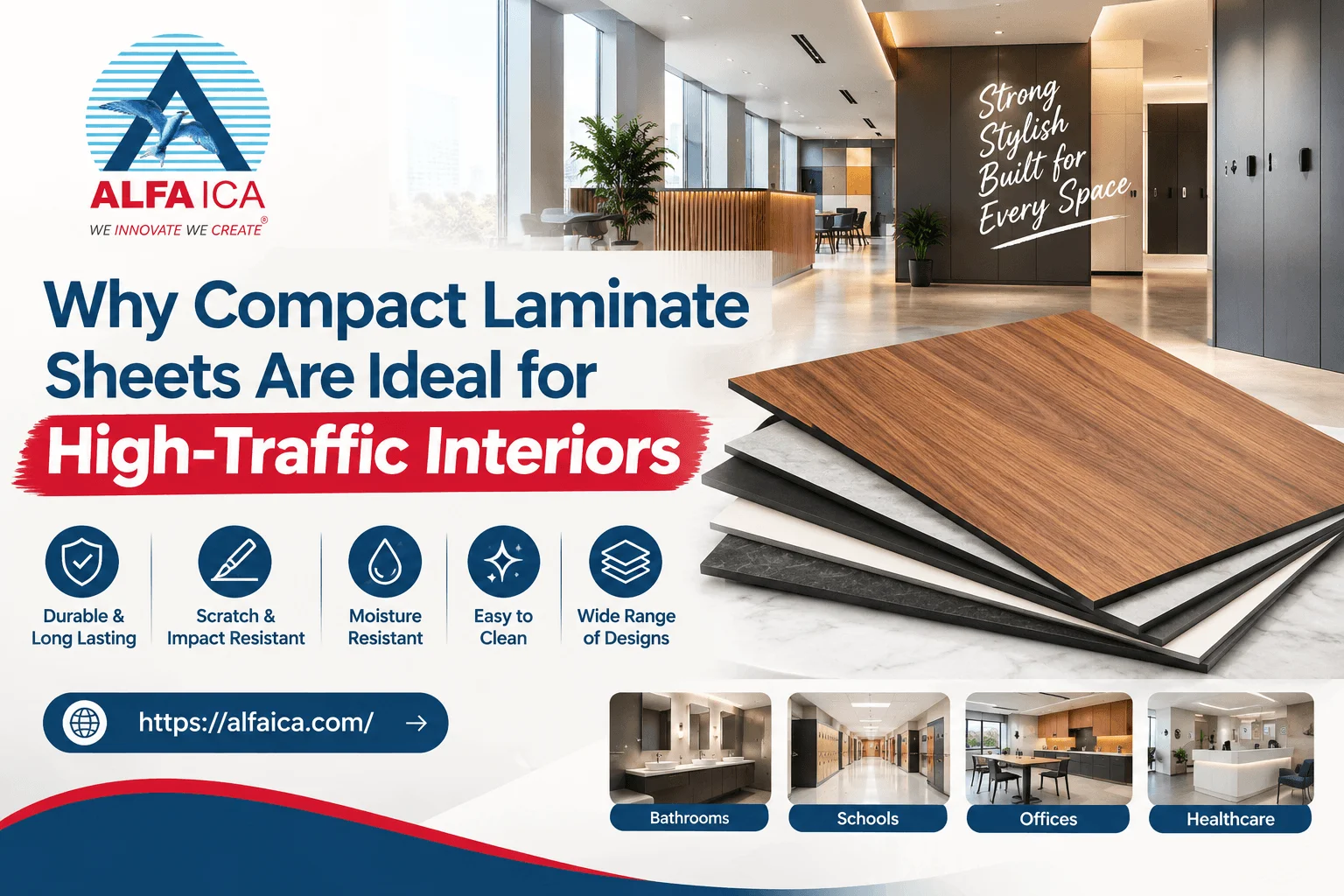
High-traffic interiors need materials that can handle frequent use without compromising appearance, hygiene, or long-term performance. From commercial washrooms and educational facilities to healthcare spaces, offices, retail stores, and hospitality environments, interior surfaces are exposed to constant contact, cleaning, moisture, and impact. Choosing the right material can therefore reduce maintenance demands and help preserve the quality of a space. A compact laminate sheet is increasingly considered for such applications because its dense construction provides strength, durability, and design flexibility. This guide explains what makes compact laminate suitable for demanding interiors, where it works best, what factors buyers should evaluate, and how to select the right product for a specific project.
Why Are Compact Laminate Sheets Suitable for High-Traffic Interiors?
Compact laminate sheets are suitable for high-traffic interiors because they combine a dense structure, surface durability, moisture resistance, easy maintenance, and design flexibility. They can withstand repeated daily use in applications such as partitions, lockers, wall panels, countertops, and furniture while maintaining a clean and consistent appearance when properly specified and installed.
What Is a Compact Laminate Sheet?
A compact laminate sheet is a high-pressure decorative laminate manufactured by pressing multiple layers of resin-impregnated kraft paper under controlled heat and pressure. Unlike conventional decorative laminates that generally require a separate substrate, compact panels have a substantial self-supporting core.
This construction gives the material a combination of rigidity, surface performance, and resistance to everyday wear. Depending on the product specification, panels can be manufactured in different thicknesses, colours, textures, and finishes.
They are commonly considered for environments where interior surfaces experience:
- Frequent physical contact
- Repeated cleaning
- Moisture exposure
- Abrasion and scratching
- Impact from everyday use
The exact performance depends on the panel’s composition, thickness, surface finish, installation method, and manufacturer’s technical specifications.
Why Does Compact Laminate Perform Well in Busy Interiors?
The biggest advantage is its ability to balance durability with practical maintenance requirements. In a busy commercial environment, replacing damaged panels frequently can create additional labour, material, and downtime costs.
A well-specified panel can help address these concerns through several characteristics.
1. Strong and Dense Construction
The multiple-layer construction creates a rigid panel that can be used in applications where ordinary decorative surfaces may not provide sufficient structural performance.
This is particularly useful for partitions, cubicle systems, lockers, furniture components, and wall applications where the material needs to remain stable during regular use.
2. Resistance to Everyday Wear
High-traffic spaces experience constant rubbing, contact, movement, and cleaning. Surface durability is therefore an important consideration.
The decorative surface of a compact sheet laminate can provide resistance to common forms of everyday wear when the appropriate grade and finish are selected.
However, buyers should always check technical data rather than assuming every laminate product offers identical resistance.
3. Moisture Resistance
Moisture is a major concern in washrooms, changing rooms, healthcare environments, kitchens, and other service areas.
Compact laminate construction can make these panels suitable for applications where humidity or occasional water exposure is expected. Correct edge treatment, fixing methods, ventilation, and installation details remain important because no material should be treated as completely immune to environmental conditions.
Where Can Compact Laminate Be Used?
The material is particularly useful where aesthetics and practical performance need to work together.
Common applications include:
- Washrooms and changing rooms: Used for partitions, cubicles, vanity components, and related interior elements.
- Educational and commercial spaces: Suitable for lockers, furniture, wall panels, and high-use areas.
- Healthcare and hospitality: Can be considered for selected furniture, partitions, and interior surfaces where cleanability and durability are important.
For example, a school corridor may experience hundreds of daily interactions with lockers, benches, doors, and wall-mounted surfaces. Selecting a robust surface material can help reduce visible wear and simplify routine maintenance.
How Does Compact Laminate Help With Maintenance?
Maintenance is not only about cleaning. It also involves accessibility, replacement frequency, surface appearance, and the availability of suitable cleaning procedures.
Smooth, non-porous decorative surfaces are generally easier to clean than materials with highly textured or absorbent surfaces. However, cleaning products should always be compatible with the manufacturer’s recommendations.
A practical maintenance approach includes:
- Following the manufacturer’s cleaning instructions.
- Removing spills promptly.
- Avoiding unnecessarily abrasive cleaning methods.
- Inspecting edges, joints, and fixing points periodically.
- Using appropriate hardware for the intended environment.
Good maintenance can extend the useful service life of an interior installation and preserve its appearance.
How Should You Choose the Right Compact Laminate?
Choosing a panel based only on colour or price can lead to problems later. The application should determine the specification.
Consider these factors before purchasing:
- Application: Determine whether the panel will be used for partitions, furniture, wall cladding, lockers, or another purpose.
- Thickness: Select a thickness appropriate for structural requirements, dimensions, fixing method, and expected loading.
- Surface finish: Consider whether a smooth, textured, matte, or decorative finish is appropriate.
- Environmental exposure: Assess moisture, humidity, heat, cleaning frequency, and expected traffic.
- Technical documentation: Review product specifications, installation guidance, and relevant performance information.
What Should You Consider When Comparing Compact Laminate Suppliers?
Working with reliable compact laminate suppliers can make product evaluation easier, particularly for commercial projects requiring consistent quantities and specifications.
Before making a purchase, compare suppliers based on technical information rather than appearance alone. Ask for product datasheets, available thicknesses, surface options, installation guidance, and information about quality-control procedures.
It is also sensible to clarify lead times, batch consistency, packaging, delivery conditions, and after-sales technical support before placing a large order.
A Simple Comparison Framework
| Factor | Basic Interior Surface | Compact Laminate |
| Structural density | Depends on substrate | High-density construction |
| Moisture suitability | Product dependent | Generally suitable for selected moisture-prone applications |
| Maintenance | Depends on finish | Generally straightforward with suitable cleaning |
| Impact resistance | Varies considerably | Designed for demanding applications |
| Design choices | Usually available | Wide range of colours and finishes |
| High-traffic suitability | Application dependent | Well suited to many high-use applications |
The table provides a general comparison. Actual performance should always be confirmed using the manufacturer’s technical documentation.
What Are the Common Mistakes to Avoid?
Even a durable material can perform poorly if it is incorrectly specified or installed.
Common mistakes include:
- Selecting thickness based solely on cost.
- Ignoring moisture or environmental conditions.
- Choosing incompatible cleaning chemicals.
- Using unsuitable hardware or fixing systems.
- Failing to account for panel movement and installation tolerances.
- Assuming every product has the same fire, moisture, impact, or chemical resistance.
Installation quality matters just as much as material selection. Panels should be fabricated and installed according to the manufacturer’s recommendations and the requirements of the specific project.
Expert Insights for Long-Term Interior Performance
For a high-traffic project, material selection should be treated as a lifecycle decision rather than simply a purchase decision.
A useful evaluation process is:
- Define the environment: Identify traffic levels, moisture, cleaning frequency, and expected service conditions.
- Match performance to application: Select the grade, thickness, finish, and construction appropriate for the intended use.
- Verify documentation: Review technical specifications and relevant certifications before ordering.
- Evaluate installation: Confirm that fabricators and installers understand the recommended fixing and finishing methods.
- Plan maintenance: Establish suitable cleaning and inspection procedures from the beginning.
For larger commercial projects, keeping product datasheets, purchase records, installation instructions, and warranty information can also simplify future maintenance and replacement decisions.
Key Takeaways
- Compact laminate is designed for applications where durability and practical maintenance are important.
- Its dense construction makes it suitable for many demanding interior applications.
- Moisture exposure, impact, cleaning requirements, and traffic levels should influence material selection.
- Product thickness, finish, hardware, fabrication, and installation all affect final performance.
- Buyers should evaluate technical documentation rather than relying solely on appearance or price.
- Proper maintenance and installation are essential for achieving dependable long-term performance.
Conclusion
High-traffic interiors demand materials that can withstand repeated use while remaining practical to maintain and visually appealing. Compact laminate offers a useful combination of dense construction, surface durability, moisture suitability for selected applications, and design flexibility.
The best results come from matching the material specification to the actual environment. Buyers should assess thickness, finish, exposure conditions, installation requirements, technical documentation, and long-term maintenance rather than choosing solely on appearance or initial cost.
Whether used in commercial, educational, healthcare, hospitality, retail, or public interiors, the right compact laminate sheet can support durable and functional interior design. Learning more from a qualified manufacturer or specialist supplier can help project owners and designers make informed decisions based on the intended application and performance requirements.
No comment